
How Internationally Educated Nurses Can Get Licensed in Newfoundland & Labrador
By Cloud Base Consultant (CBC) | Healthcare Professional Immigration Specialists, Kuwait & Coimbatore

You have years of bedside experience, a nursing qualification you worked hard for, and a dream of building your career in Canada. Then you open a regulator's website and find ECAs, CPNRE, currency of practice, SPEPP and a list of documents that seems to grow with every click.
You're not alone. Every year, nurses from India, the Gulf, the Philippines, Africa and beyond start the Canadian licensing journey. Many lose months to avoidable errors: an ECA sent to the wrong place, a police certificate that has expired, practice hours that don't count.
This guide walks you through the licensing process of the Newfoundland and Labrador College of Nurses (NLCN) for internationally educated Licensed Practical Nurses (LPNs) and Registered Nurses (RNs) who hold no licence in another Canadian province. It covers pathways, costs, documents and the mistakes to avoid.
Table of Contents
- What Is NL Nurse Licensing for Internationally Educated Nurses?
- Why It Matters in 2026
- Latest Updates and Trends
- Eligibility Requirements
- Step-by-Step Application Process
- Costs and Processing Times
- Your Outcome: Pathways A, B, C and D
- Temporary Licence and SPEPP Explained
- Common Mistakes to Avoid
- Real-Life Examples
- Benefits and Opportunities
- Frequently Asked Questions
- Conclusion and Next Steps
1. What Is NL Nurse Licensing for Internationally Educated Nurses?
In Canada, nursing is regulated province by province. To practise in Newfoundland and Labrador (NL), you must be registered with the NL College of Nurses (NLCN). Registration means the College has confirmed that your education, recent practice and English ability meet the provincial standard and that you're safe to practise.
This process applies to you if:
- You trained as an LPN outside Canada and hold no LPN licence in another Canadian province or territory, or
- You trained as an RN outside Canada and hold no RN licence in another Canadian province or territory.
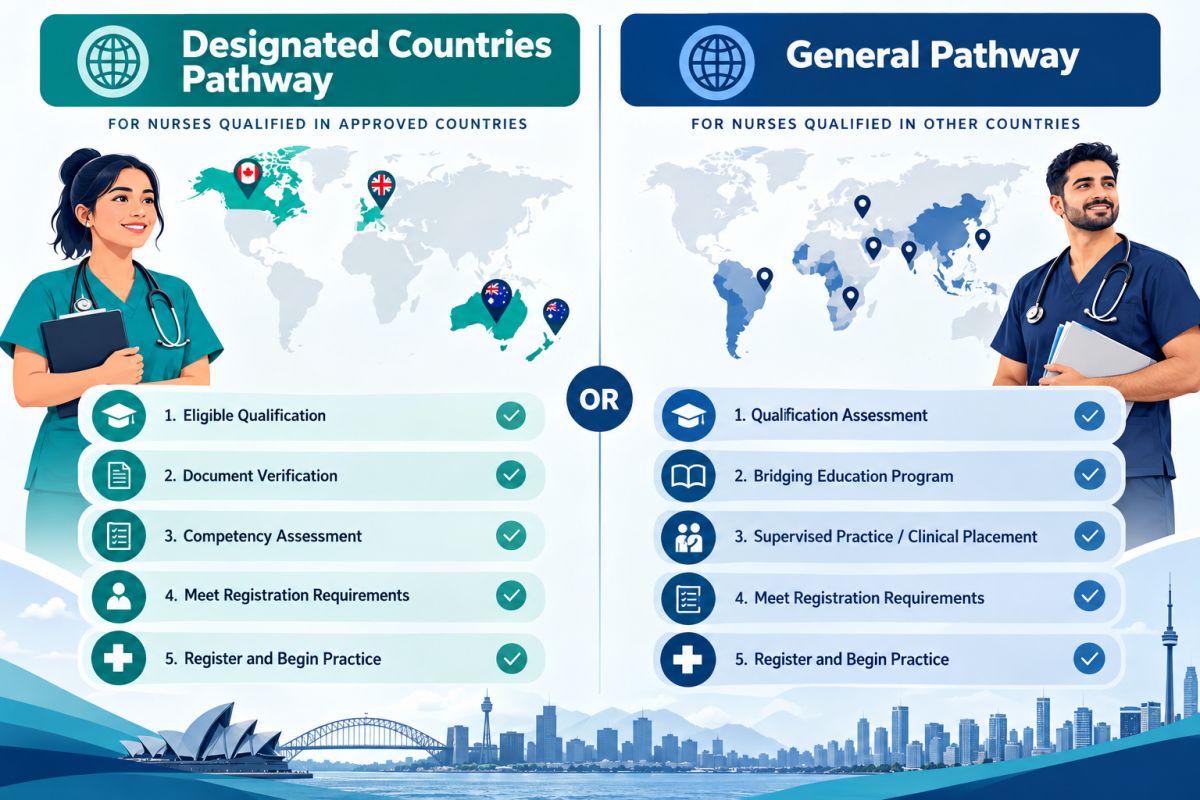
The College sorts every applicant into one of two assessment pathways, depending on where you completed your entry-level nursing education. We cover that next.
Designated Countries Pathway
If your entry-level RN education was completed in Australia, Ghana, Hong Kong, Ireland, India, New Zealand, Nigeria, Pakistan, the Philippines or the UK, you meet the education requirement automatically.
General Pathway
You're on the General Pathway if:
- Your entry-level LPN education was completed in the USA, or
- Your entry-level education was completed outside a designated country.
This pathway needs a further competency assessment through Inspire Global.
Important for Kuwait-based nurses: Kuwait isn't on the designated list. If your entry-level education was completed in one of the designated countries above (for example, India or the Philippines), that is what counts, not where you work today. Your place of education decides your pathway, not your place of employment.
2. Why It Matters in 2026
Canada's healthcare system continues to face workforce pressure, and provinces with rural and remote communities, including Newfoundland and Labrador, actively look for nurses.
For internationally educated nurses this means:
- Real demand. Employers recruit internationally.
- A pathway to permanent residency. Healthcare occupations are often prioritised in Canadian immigration programs, and a provincial licence strengthens your PR options.
- Career stability. Canadian nursing offers competitive pay, benefits and a strong work-life balance.
Licensing is the gate to all of it. Without it, you can't legally work as a nurse in the province.
3. Latest Updates and Trends
- Regulators are becoming more supportive of internationally educated nurses. Bridging and supervised practice options, such as the SPEPP described below, exist because provinces want qualified newcomers working sooner.
- Temporary licences let some applicants start working under a defined licence while completing final requirements.
- Digital, portal-based applications are now standard, so accurate account setup and document upload matter more than ever.
- Demand for healthcare professionals continues to influence immigration policy.
Rules change. Always confirm current requirements with the NLCN before applying.
4. Eligibility Requirements
To register, you generally need to satisfy five core areas.
a) Educational Credential Assessment (ECA)
If you were educated outside Canada, you need an ECA. It confirms you graduated from an accredited program and sets the academic level (diploma or degree) of your credential in Canada.
Key rules:
- The ECA must be sent directly to the College by the issuing organization.
- Receive your ECA report before submitting your application.
- Already have an ECA for immigration? Ask the provider to send a copy. A Standard Version upgrade may be required.
- ECA fees are paid directly to the provider you choose.
Approved ECA providers:
- World Education Services (WES)
- Comparative Education Service, University of Toronto
- International Credential Assessment Service of Canada (ICAS)
- International Qualifications Assessment Service (IQAS)
- International Credential Evaluation Service, BCIT
- National Nursing Assessment Service (NNAS)
b) English Language Proficiency
All applicants must demonstrate acceptable English. The College reviews your file to decide whether a language test is required and tells you the scores you need.
c) Criminal Record Check (CRC)
If you live outside Canada, you must submit a CRC for every country you have lived in.
d) Translated Documents
Any supporting document not in English needs an official translation by a certified translator, or a certified true copy of the English original.
e) Currency of Practice
Before licensure, you must meet at least one of the following:
- Graduated from an entry-level nursing program in the last 3 years, or
- Practised 1,125 hours in the last 5 years or 450 hours in the last 2 years, or
- Completed an approved re-entry program in the last 3 years.
Watch this detail: Practice hours only count if you were licensed as an RN or LPN in the country, state or province where you worked them.

5. Step-by-Step Application Process
Internationally educated nurses apply as an Exam Candidate. Here is the sequence.
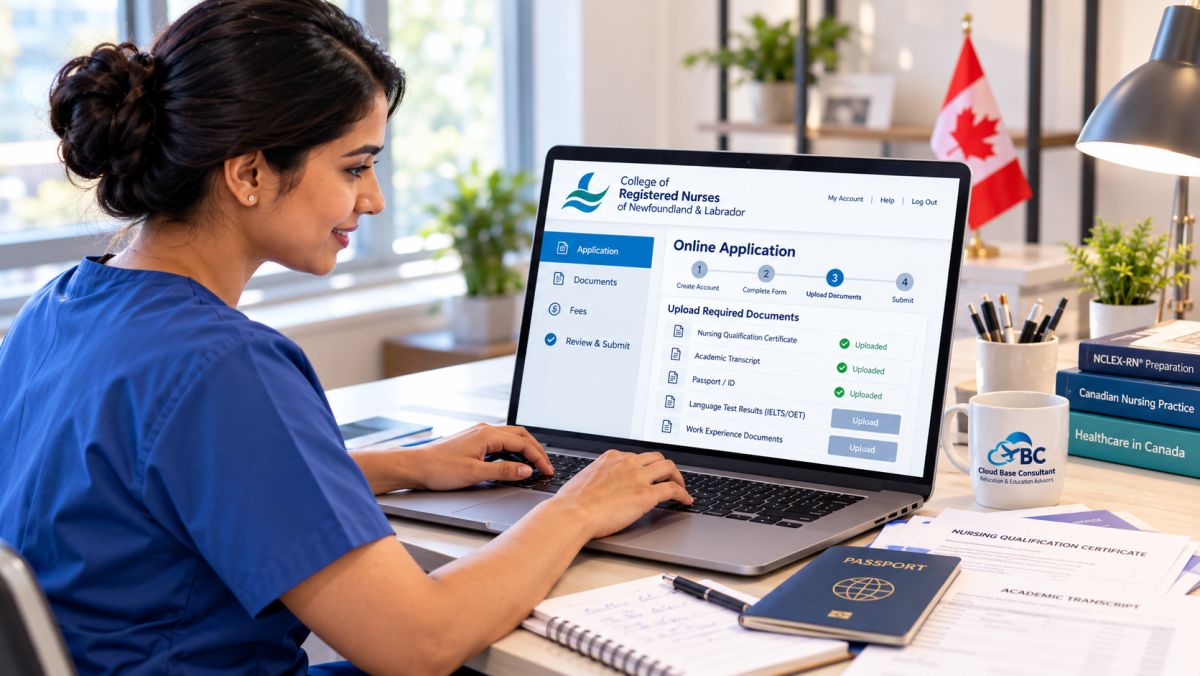
Step 1: Sign up. Create your account on the College's online portal.
Step 2: Apply as an Exam Candidate.
Step 3: Upload two government IDs. One must have a photo (passport, driver's licence or birth certificate). Add a name-change document if applicable.
Step 4: Pay the application processing fee. It is $231.04 CAD (including HST) and non-refundable once review begins.
Step 5: Provide Verification of Nursing Licensure. Do this for every jurisdiction where you are, or have been, registered.
Step 6: Declare your nursing employment history. Cover the last 5 years, including any suspension or termination.
Step 7: Self-report your practice hours. Currency of practice covers the last 5 years.
Step 8: Submit the application and pay the fee invoice. Processing starts only once paid.
Document Checklist
DocumentWho provides itTwo government-issued IDsYou, via the Nurse PortalECA reportSent directly by the ECA provider to the CollegeVerification of Registration (if required)Issuing regulator, directly to the CollegeNursing employment history (last 5 years)Self-reported by youEnglish test results (if required)Approved language testing agencyCertified translations (if applicable)Certified translatorCriminal Record CheckYou, from the local/national police service
6. Costs and Processing Times
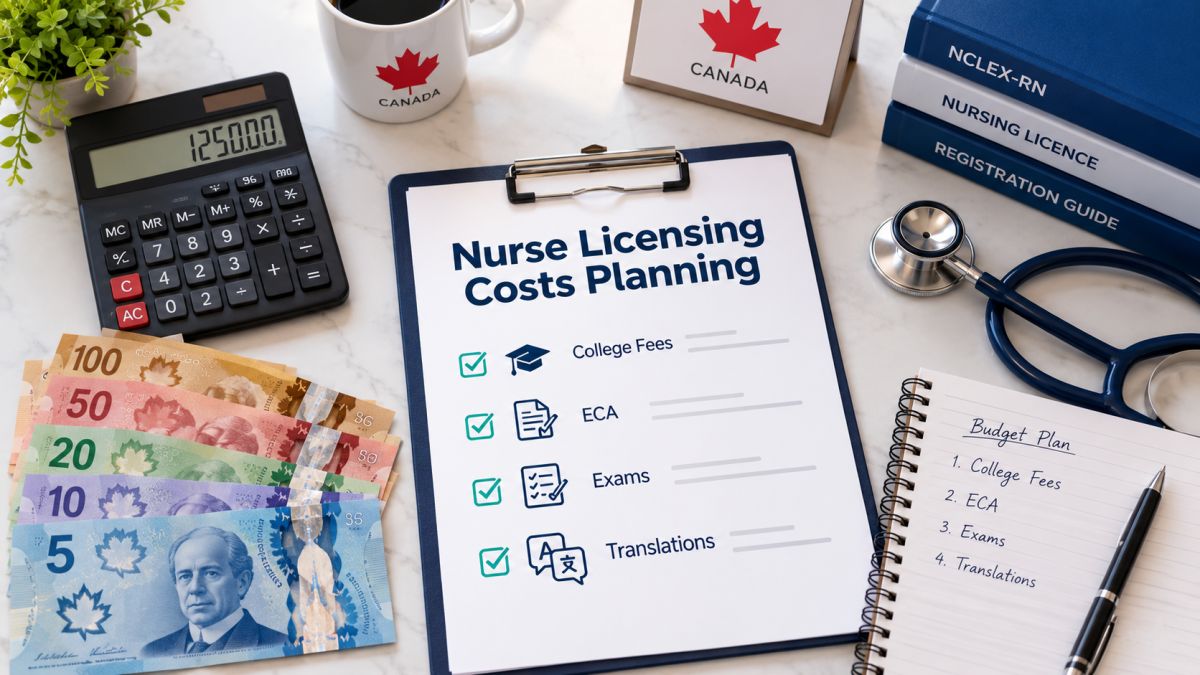
ItemCostExam Candidate application processing fee$231.04 CAD (incl. HST)Temporary Licence fee (optional)$156 CADCPNRE exam fee$690 CAD Police check screening fee, per country$196 CADJurisprudence Learning ModuleFree
Additional costs to budget for: ECA provider fees, language test fees (if required), certified translations, police certificates and, if you are placed in a bridging pathway, program tuition.
Processing times: These depend on how quickly third parties send documents (ECA providers, regulators, police services) and how complete your file is. A complete, correctly sequenced application is the biggest factor in speed.
7. After Review: Your Outcome Pathway
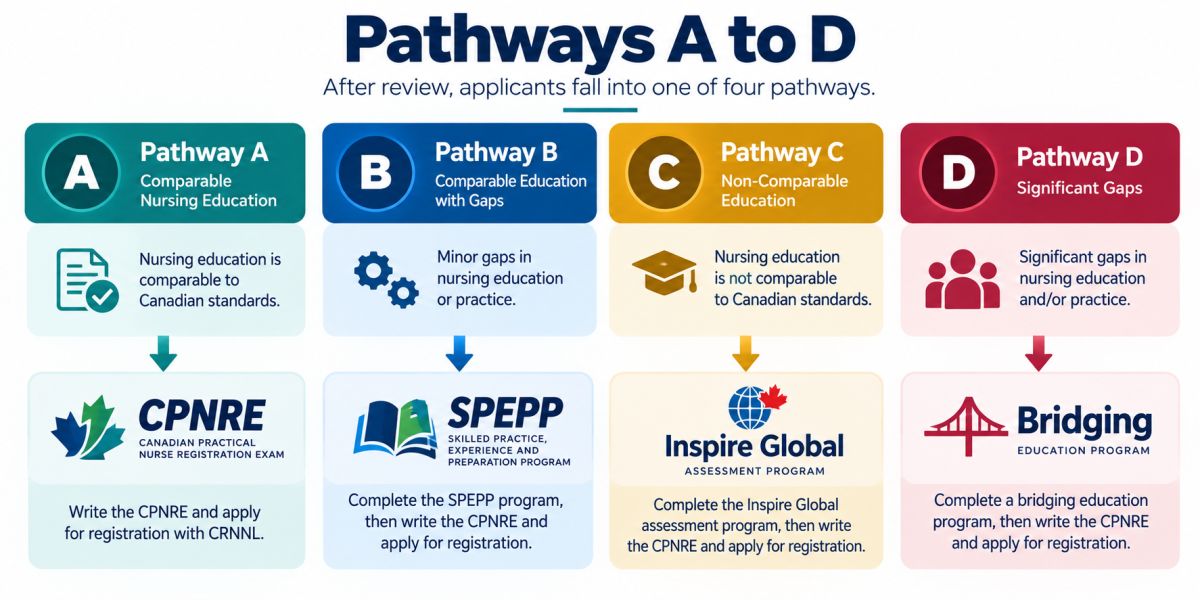
Once the College reviews your file, you'll land in one of four outcomes.
Pathway A: Meets Education and Currency of Practice (Designated Countries)
- You're eligible to write the CPNRE (Canadian Practical Nurse Registration Examination).
- If you have NL employment lined up, you may apply for a 4-month Temporary Licence once the CPNRE fee is paid.
Pathway B: Meets Education, Not Currency of Practice (Designated Countries)
- You may be eligible for a Temporary Licence to join the Supervised Practice Experience Partnership Program (SPEPP), or
- You may be required to complete the LPN Re-Entry Program.
Pathway C: Does Not Meet Education Requirements (General Pathway)
- Complete the Inspire Global competency assessment (computer-based plus in-person).
- Depending on results, you may need select courses or the full bridging/re-entry program.
- If you're missing specific content, such as paediatrics, a restricted Temporary Licence may allow you to practise while bridging.
- After assessment and education, the College confirms next steps for your Temporary Licence and CPNRE.
Pathway D: Meets Neither Education nor Currency of Practice (General Pathway)
- Complete the full internationally educated nurse (IEN) bridging/re-entry program, or
- The application may be denied.
8. Temporary Licence and SPEPP Explained
Applying for a Temporary Licence
- Submit the temporary licensure application.
- Pay the Temporary Licence fee.
- Complete the free Jurisprudence Learning Module (NL Provincial Continuing Education Portal).
- Submit an original Criminal Record Check dated within 6 months.
Once approved, your Temporary Licence is processed and you'll appear in the College's Search for a Nurse directory. Passing the CPNRE and meeting all requirements converts it to an Initial Licence at no extra cost, valid until March 31.
SPEPP: For Nurses Who Meet Education but Not Practice Hours
- Pass the CPNRE before starting SPEPP.
- Secure an NL employer, then apply for a 6-month Temporary Licence.
- Complete 450 practice hours, including at least 135 hours under direct supervision of an experienced LPN/RN preceptor.
- Completing SPEPP satisfies the currency of practice requirement.
This is a valuable route for nurses who took career breaks, worked in unlicensed roles or whose hours didn't qualify.

9. Common Mistakes to Avoid
- Starting the application before receiving your ECA. The ECA must reach the College first.
- Having the ECA sent to you instead of the College. It has to come directly from the provider.
- Assuming your work country decides your pathway. Your country of education does.
- Counting unlicensed hours. Hours count only if you were licensed where you worked them.
- Missing police checks. You need one for every country you have lived in.
- Using an old police certificate for a Temporary Licence. It must be dated within 6 months.
- Uncertified translations. Only certified translators or certified true copies are accepted.
- Leaving gaps in your employment history. Declare the last 5 years fully, including any suspension or termination.
- Forgetting to pay the invoice. Processing starts only once you've paid.
- Applying for a Temporary Licence before securing NL employment. For Pathway A and SPEPP, an NL employer is part of the process.
10. Real-Life Examples
Example 1: Pathway A. A nurse educated in India with steady, licensed practice in the last two years meets education and currency. She applies as an Exam Candidate, books the CPNRE and, with an NL job offer, applies for a 4-month Temporary Licence.
Example 2: Pathway B. A nurse educated in the Philippines took a long career break. She meets education but not currency. She writes the CPNRE, secures an NL employer and completes SPEPP: 450 hours, 135 of them supervised.
Example 3: Pathway C. A nurse educated outside a designated country completes the Inspire Global assessment and learns she needs a paediatrics course. A restricted Temporary Licence lets her work while she completes it.
The lesson: your pathway is set by your background, and a good plan turns each pathway into a timeline.
11. Benefits and Opportunities
- Meaningful work in a province known for its tight-knit communities
- Employer support through recruitment programs
- A stepping stone to permanent residency through employment and provincial programs
- Career growth, from LPN to RN bridging and specialisation
- Family-friendly living, with affordable housing compared with larger Canadian cities
12. Frequently Asked Questions
1. Who can apply to the NL College of Nurses as an internationally educated nurse?
Nurses who trained as an LPN or RN outside Canada and hold no licence in another Canadian province or territory.
2. Which countries are on the designated countries list?
Australia, Ghana, Hong Kong, Ireland, India, New Zealand, Nigeria, Pakistan, the Philippines and the UK. Entry-level RN education in these countries meets the education requirement automatically.
3. I work in Kuwait. Which pathway applies to me?
Your pathway is based on where you completed your entry-level education, not where you work. A nurse educated in India would be on the Designated Countries Pathway even if working in Kuwait.
4. What is an ECA and why do I need one?
An Educational Credential Assessment confirms you graduated from an accredited program and sets the level of your credential in Canada. It must be sent directly to the College.
5. Can I use my immigration ECA?
Possibly. Ask your provider to send a copy to the College. A Standard Version upgrade may be required.
6. Which ECA providers are accepted?
WES, Comparative Education Service (University of Toronto), ICAS, IQAS, ICES (BCIT) and NNAS.
7. Do I need an English test?
The College reviews your file and tells you whether a test is required and which scores you need.
8. What is currency of practice?
Recent practice. You must have graduated within 3 years, or practised 1,125 hours in 5 years / 450 hours in 2 years, or completed an approved re-entry program in 3 years.
9. How much does the process cost?
Key College fees are $231.04 CAD for the application, $690 CAD for the CPNRE, $156 CAD for an optional Temporary Licence and $196 CAD per country for police check screening. ECA, language test and translation costs are separate.
10. What is a Temporary Licence?
A short-term licence allowing you to practise while completing final requirements. Passing the CPNRE converts it to an Initial Licence at no extra cost.
11. What is SPEPP?
A supervised practice program for candidates who meet education but not practice-hours requirements: 450 hours, at least 135 directly supervised, within a 6-month Temporary Licence.
12. What happens if I don't meet education requirements?
You complete the Inspire Global assessment. You may then need select courses or a full bridging program.
13. Can my application be denied?
Yes. If you meet neither education nor currency requirements and don't complete bridging, your application may be denied.
14. Can Cloud Base Consultant help with my application?
Yes. CBC assists with credential assessment, document preparation, pathway planning and immigration strategy, including PNP and Express Entry options.
Conclusion
Getting licensed in Newfoundland and Labrador comes down to five things: knowing your pathway, getting your ECA right, meeting currency of practice, submitting the right documents in the right order and planning your budget. Each is manageable once you understand the steps.
Key takeaways:
- Your country of education determines your pathway.
- The ECA must go directly to the College before you apply.
- Only licensed practice hours count toward currency.
- Temporary Licences and SPEPP can help you start working sooner.
- A complete, accurate file is the best way to avoid delays.
Ready to Start Your Nursing Career in Canada?
At Cloud Base Consultant (CBC), we guide healthcare professionals through credential assessment, licensing pathways, work permits and permanent residency. Our teams in Kuwait and Coimbatore will review your qualifications, identify your pathway and build a clear plan.
- 👉 Free Eligibility Assessment: Send us your details today.
- 💬 WhatsApp Inquiry: +965 66591255
- 📧 Email: inquiry@cloudbaseconsultant.com
- 🌐 Website: www.cloudbaseconsultant.com
- 📍 Office: Mirqab, Fahad Al Salem St, Saadoun Al Yaqoub Complex, 5th Floor, Office #9, Kuwait
Book your consultation with Cloud Base Consultant today and take the first step toward Canada.

Disclaimer: This article is for general guidance only and isn't legal advice. Regulatory requirements and fees are set by the NL College of Nurses and may change. Confirm current details before applying.
Other Blogs

INTERNATIONAL EDUCATED PHYSICIANS CAN GET LICENSED IN SASKATCHEWAN
Planning to work as a doctor in Canada? Explore the Saskatchewan SIPPA pathway for internationally trained physicians, including licensing requirements, exams, costs, and job opportunities

How Internationally Educated Physicians Can Get Licensed in Canada (2026 Guide)
Learn how internationally educated physicians get licensed in Canada — eligibility, PER vs PRA, costs, timelines, and how CBC can help

Unlock Your Global Future with Premier Study Abroad Consultants in Kuwait
Study abroad consultants in Kuwait providing expert guidance for overseas education, student visa services, SAT & PTE coaching, and university admissions support.
